Yemi Adeyemi had not been to the doctors in four years and it wasn’t because she didn’t give it a thought, but because she didn’t have the time. She worked long hours in a London marketing agency, had irregular eating habits, an irregular sleeping schedule, and was aware of all this, but did relatively little about it. The changes were not caused by a health scare or New Years resolution. The benefit was added by her employer: A digital wellness program that included fitness plans, sleep coaching, guided meditation, and metabolic health monitoring via an on-going glucose monitor connected to the app. After six months, Yemi had lost nine kilograms, lowered her resting heart rate by 11 beats per minute and slept an average of a forty minute longer sleep per night than at the beginning. Finally she did get a check-up with her GP, and fitness app development he told her that all her blood tests were those of a person 10 years younger.
Yemi had not completely changed her life. She was assigned a system that would make the correct decision just a little bit more difficult than the wrong one each day, and this discrepancy magnified over time. This is what quality work from any serious Fitness App Development Company can look like when it gets to the right person at the right time with the right product design something that isn’t an intervention, but is more subtle, more persistent, more non-intrusive, and more of an environment for making better decisions. When you apply that impact to the tens of millions of people who now have that infrastructure in their pocket, you start to realize the power of digital health & wellness and how it has transitioned from novelty to a real force changing population health behaviors.
The Scale of the Shift
The digital health market has expanded faster than anyone could have imagined, and this is happening worldwide. Fitness apps are among the highest usage software categories on both iOS and Android, and their daily active usage is something most productivity and social apps would be jealous of. It is not a coincidence. Smartphones are the most personal computing devices ever: they’re everywhere at workouts, during meals, at night while you’re sleeping and when you’re not doing much at all. If an application is able to be part of the existing moments in the day, it is more likely to generate engagement than any wellness intervention that has to carve out time out of a busy day.
Adoption of fitness apps has also increased significantly among the early adopter fitness enthusiast, and has broadened its reach beyond. User segments that didn’t exist a decade ago are older adults enrolling in mobility and balance training programs, individuals with chronic conditions, such as type 2 diabetes, receiving lifestyle intervention support, cardiac rehabilitation patients opting for supervised remote exercise programs, and corporate employees who access mobility and balance training programs, lifestyle intervention support and employer-funded wellness platforms, respectively. Every growth in users has driven product development down with a broader concept of health than the original performance-centric category implied.
Personalization as the Central Product Problem
The fitness history is as much a history of generic recommendations for too diverse a population to be suitable for any one protocol. For the most part, the typical exercise recommendations (150 minutes of moderate aerobic exercise per week, 2 sessions of resistance training, enough sleep, and a balanced diet) are supported by the evidence at the population level, but have little relevance to the individual who has to figure out what to do on a Tuesday morning, given their history, limitations, preferences, and constraints.
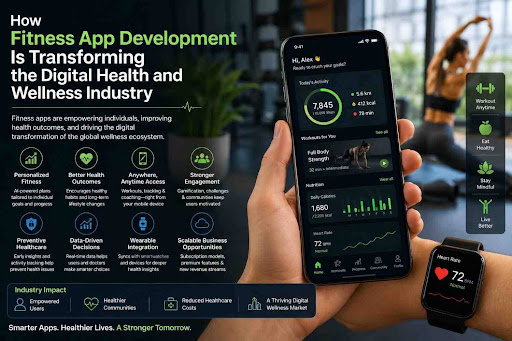
At their heart, digital health apps are personalization engines. This data – from exercise history, physiological responses measured through the integration of wearable devices, nutrition tracking, sleep monitoring, and self-reported wellness scores – forms a profile of the person over time, enabling truly personalized guidance at scale for the first time. A recommendation stating “Based on your sleep over the last 5 days and training load this week, today’s session should focus on mobility work and reduce output” is not the same as a rigid training plan that doesn’t know who you are.
The personalisation issue is more complex than it appears on the surface. The data needed to make good recommendations is sensitive, is spread across many devices and services, and is of varying quality. The algorithms that act upon it must be able to discriminate between information and noise in data sets without missing the signal, especially when there is little or no ground truth. And the recommendations must be communicated in a manner that inspires rather than overwhelms a decision. The best fitness app development teams that are progressing most towards personalization have seen it as a continual research issue instead of a feature to be shipped and tweaked away from.
The Clinical Adjacency, remote Health Monitoring
A big milestone in digital wellness is the convergence of consumer fitness apps and clinical health monitoring. New devices that consumers wear mostly to track their fitness use the same physiological data with sufficient clinical relevance as they were developed to detect atrial fibrillation, to monitor blood oxygen saturation, to flag patients at risk of sleep apneas, and to create continuous heart rate data that cardiologists are starting to use in patient management.
The convergence is generating a new application category of sorts between the consumer wellness product and the regulated medical device. In this space are remote patient monitoring programs that leverage consumer-available wearables to assess cardiac rehab patients between clinical visits, mental health applications that rely on physiological parameters in addition to self-reported symptoms, and chronic disease management applications that encourage lifestyle behavior change in addition to medication adherence.
The regulatory landscape is also shifting to accommodate these applications. These digital health initiatives, such as the FDA digital health framework, the EU Medical Device Regulation, as it applies to software, and other initiatives in countries like the GCC, India and Southeast Asia, are creating a clearer demarcation between wellness apps and regulated medical software. As developers create in this space, they are more likely than ever to have to make purposeful architectural and clinical validation choices early in the product lifecycle and not learn about regulatory requirements when they have reached user scale.
Mental Wellness Integration and the Whole-Person Model
The category of Fitness started with physical performance and has slowly evolved in its definition of what fitness and health are to include mental and emotional wellness. That growth has been driven by both user demand as well as a growing body of evidence that shows that physical and mental health cannot be treated separately. Poor quality sleep impacts mood control and cognitive function. Chronic stress raises cortisol which negatively affects recovery from physical stress and increases risk of injury. There is a relationship between sedentary behaviour and depression risk that is measurably decreased by exercise.
If the application does not include a consideration of psychological context that the physical fitness works take place in, then a good deal of the potential value of the intervention is going unused. So the platforms that have built guided meditation, breathwork protocols, stress management modules, health anxiety and fitness content in the vein of CBT, and sleep coaching into their training and nutrition features are seeing engagement and outcome figures that differ from single domain applications. Product data consistently demonstrates that users who access the mental wellness features are more likely to have high retention and improved physical results compared to users who use the training features only.
The Employer Wellness Channel
In the past, corporate wellness investments have yielded poor returns because the interventions covered by the wellness dollars step challenges, on-site yoga, fruit bowls have had a shallow impact on behavior change, in the best of circumstances. Employer value proposition has been transformed by digital health and wellness platforms because they offer interventions that are sophisticated enough to create measurable population health benefits for the cost of a platform that can be deployed at scale across large populations without a corresponding increase in staff.
Yemi’s benefit was not an unusual one, considering it was paid for by her employer. The adoption of digital wellness platforms by companies has been steady over the years and is supported by evidence that it is possible to meaningfully reduce health insurance claims, absenteeism and presenteeism by designing and implementing digital interventions effectively for the employees. The data these platforms offer also enables employers to access population-level health analytics, appropriately anonymised and aggregated to support their benefits design decisions using evidence not possible from point-in-time surveys or claims data.
The employer channel has also been a catalyst for quality of platforms. Unlike the distribution through an app store, corporate purchasers have procurement processes and legal teams that will not only review privacy practices, but also seek clinical evidence and outcome measurement methodologies. Those that have managed to sell into enterprise wellness programs have tended to develop more robust product infrastructure as a result.
Where the Category Is Heading
The future of fitness app development is a digital health continuum that will further blur the lines between fitness, nutrition, mental health, sleep medicine, chronic condition management, and preventive healthcare in an app experience. The tech working behind this convergence wearing clinical-grade sensors, large language models that turn complex health data into digestible guidance, and behavioral science principles baked into the products’ design is progressing far quicker than the regulatory and reimbursement frameworks that will allow these platforms to be integrated into formal health care systems.
For now, Yemi’s story comes to an end with a GP appointment better than anticipated, and a routine that is felt to be bearable, not too much. There was no cure or diagnosis. It made things that it already knew about itself, visible, and slightly more obvious than the next wrong thing to do, the next right thing to do. When the digital health and wellness industry works on this scale, that small decision change day-to-day, when applied to millions of people, is creating population-level health changes that researchers are just starting to measure systematically. The change is genuine and it’s early.
also read this –