Introduction
Many businesses want to reach customers in different countries. They invest in websites, content, and some digital marketing efforts to push further globally, but well.. it is still not really that straightforward. Still, expanding internationally is usually not just “translate and go”.
From what I’ve seen, a lot of businesses have trouble ranking in foreign markets even after they spend serious resources on content and SEO. Search engines need clear cues, like the kind that tells them what country and language you are aiming for, otherwise they just can’t connect the dots.
That’s where an international SEO specialist, or if you prefer international search optimization, starts to matter.
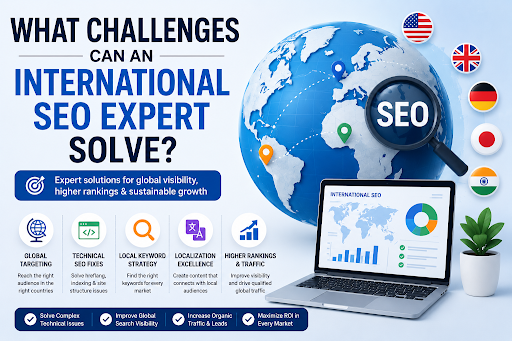
An international SEO expert assists businesses with the usual technical issues, content hurdles, and localization confusion that keep websites from performing in multiple countries. With the proper plan in place, companies can raise their visibility , pull in more qualified visitors, and yes, usually grow global revenue too.
In this piece, I will walk through the main challenges an international SEO expert can help with and also why these fixes really count for international growth.
The Growing Importance of International SEO
As per data available from Statista , global eCommerce sales are expected to top $8 trillion in the coming years. More consumers than ever are buying products and services from overseas brands, and in a kinda consistent way lately.
However, global expansion throws in fresh SEO challenges, you know the kind.
A website that looks strong in one country might not perform as well in another . Different languages, search habits, cultural tastes, and even particular search engines mean you end up needing distinct optimization tactics, not just a copy-paste.
From what I found during my own research , businesses that put money into localization and international SEO often see stronger engagement and better conversion rates versus companies that keep a one-size-fits-all approach.
Challenge 1: Targeting the Wrong Audience
One of the biggest problems a business will run into is getting visitors from countries they, well, don’t actually serve. For instance, say a company is aiming at customers in Canada, but then it somehow pulls traffic from India, Australia , or other places where its products just aren’t available.
And because of that you end up with stuff like Low conversion rates, high bounce rates. Also the overall user experience feels off, and the marketing budget basically goes wasted, like nobody really asked for those clicks.
An international SEO expert helps fix this by putting in geo targeting approaches so search engines can read which audience each page is meant for, and not just guess. Then everything lines up, in a more orderly way, so the right people land on the right content.
Challenge 2: Incorrect Hreflang Implementation
Hreflang tags are, like, one of the most important bits of international SEO honestly
These tags tell search engines which language and region version of a page should show up for certain users
Sadly many websites implement hreflang kind of wrong, sometimes.
There are a few usual slip ups, for example, missing hreflang tags, or using wrong language code formats
Also, broken page references happen a lot, plus conflicting signals, like two hreflang directions that don’t agree
When that stuff shows up it can confuse the search engines and it will lower your visibility overall
An international SEO specialist, reviews and fixes hreflang problems so search engines can present the right version of your site to people worldwide.
Challenge 3: Duplicate Content Across Countries
Many international websites use kinda similar content across a bunch of regional pages. Like, there is a US version, a UK version, an Australian version, and well sometimes it looks the same, at least at first glance. Sure each page is aimed at slightly different audiences but the wording can stay almost identical , sometimes word for word.
Search engines might start treating that as duplicate content, and then you get issues like rankings that take a hit, or certain pages that search engines basically ignore. Overall visibility could even drop.
So an international SEO expert will craft localized content strategies, in a way that pages feel genuinely different while the brand stays consistent.
Challenge 4: Poor International Keyword Research
Many businesses end up translating keywords straight across from one language to another. Like, I guess it sounds sensible at first but it is a major mistake. People in different countries often search in totally different ways even if they’re hunting for the same product, honestly.
For instance, search behavior in the United States can look very different compared to what people do in Germany, France, or Japan. And that gap matters.
An international SEO expert typically does market specific keyword research, not just generic copying, to spot things like local search trends, regional search intent, country specific phrasing, plus those keywords that actually convert.
This kind of approach boosts visibility and, in practice, pulls in more qualified visitors.
Challenge 5: Low Rankings in International Search Engines
A lot of businesses end up translating keywords straight across from one language to another. Like, I mean it feels like it should be sensible in the beginning, but then it turns out to be a big mistake, somehow. People in different countries often search in totally different ways even if they are trying to find the same thing.
For example, the way people search in the United States can look quite different compared with what folks do in Germany , France, or Japan. And that mismatch, it matters more than you think.
An international SEO expert usually does market specific keyword research, not just generic copy-and-paste work, so they can find local search trends, regional search intent, country specific phrasing plus those terms that actually lead to conversions.
This style of work helps visibility, and in real life it brings in more qualified visitors too.
Challenge 6: Weak Website Structure
Website architecture sort of kinda plays a critical role in international SEO success overall.
Lots of companies end up stuck trying to decide between:
country specific domains, subdomains, subdirectories.
If you choose the wrong layout, it can create indexing issues , and ranking complications too.
An international SEO specialist usually checks the business goals first, then recommends the best setup for global expansion.
A cleanly organized site structure helps search engines crawl, and interpret international content more effectively.
Challenge 7: Localization Problems
Translation isn’t exactly the same as localization, not really. Translation is mostly taking words and turning them into another language. Localization is more about adjusting content so it fits local culture, those local preferences, and what people there expect.
From what I’ve seen in my research, people tend to trust websites more when the text feels natural, and also relevant to where they are .
That’s where an international SEO expert becomes helpful. They support companies in building localized content that reaches users well, without losing SEO performance, and yes it’s kind of a balancing act.
This often improves:
- User engagement
- Time on site
- Conversion rates
- Customer trust
Challenge 8: Low International Organic Traffic
Many companies roll out global websites, expecting a quick spike in traffic, but it does not always happen right away. Unfortunately traffic can stay kinda low because the pages are not quite tuned for international search, like at all.
Usually, the situation comes from a mix of problems such as
- not great keyword targeting
- technical SEO troubles, hidden in the code and structure
- backlink profiles that are too weak or oddly thin
- localization gaps where language, tone, and intent do not quite match local expectations
An international SEO specialist spots these issues, then crafts a strategy (step by step, pretty detailed) aimed at improving visibility in each target country. In many cases, businesses also work alongside an AdWords PPC expert to combine paid advertising with organic SEO efforts for faster international reach and stronger lead generation.
Challenge 9: Building Authority in Multiple Countries
Backlinks still stay one of the stronger ranking factors, though not always in a straight line.
Still, a link from one country might not really do much for rankings in another market, it can feel weird like that.
For instance , a site aimed at Germany gets a clear advantage when it earns backlinks from German websites.
An international SEO specialist then builds country-by-country link-building plans, like tailored outreach or something, to raise authority in every target region.
In the end it supports better rankings and also trust signals, even when the audience is miles apart.
Challenge 10: Measuring International SEO Performance
Backlinks still stay one of the stronger ranking factors, even if it doesn’t always follow a straight line or whatever.
That said, a link from one country might not do much for rankings in another market, it can feel off, like weirdly, yes.
For example , a site aimed at Germany gets a noticeable edge when it earns backlinks from German websites.
Then an international SEO specialist builds link building plans by country-by-country, like tailored outreach or similar things, to lift authority across every target region.
In the end it can back better rankings and also those trust signals, even when the audience is pretty far apart, miles apart really.
Measuring international SEO performance requires the use of different tools for tracking rankings, organic traffic, user behavior, conversions, and country-specific search visibility.
Real-World Impact of International SEO
As I found over research, businesses applying solid international SEO methods often end up seeing real improvements in organic traffic as well as revenue, and not just a small one. In industry case studies you’ll regularly notice an upswing in organic reach, international visits , lead creation, and even online sales. The key driver behind those outcomes usually isn’t merely “translation” done the quick way, but the proper international optimization, done with intention. Firms that really grasp local search patterns and the way people behave online tend to outperform competitors who rely on generic universal tactics.
Final Thoughts
Pushing into international markets brings huge opportunities, but it also drops in these special SEO challenges that are kinda different, you know. Between hreflang issues, duplicate content and localization, plus country-specific keyword targeting, there are a lot of little hurdles that can quietly block global success.
A skilled international SEO expert usually helps a company untangle all of that, using technical SEO, outsource seo services, localized content work, market research, and a more calculated kind of optimization strategy. They also look at how search engines interpret pages across regions, so the whole structure feels consistent.
From what I’ve seen, businesses that start investing in international SEO early tend to land a real competitive edge in global markets. They connect with the right audience, boost search visibility, and build durable long-term growth, not just a short spike.
If your aim is to go beyond your current borders, partnering with an experienced international SEO expert can turn those global opportunities into results you can actually measure.