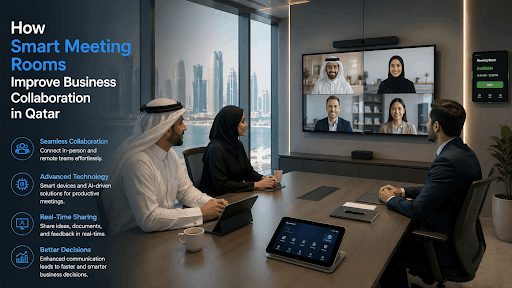
A meeting starts ten minutes late because someone can’t get the projector to recognize their laptop. Half the team dials in from a branch office, but the microphone can’t pick up voices from the far side of the table, so they spend the whole call asking people to repeat themselves. By the time the actual discussion begins, half the energy in the room is already gone. This is still a daily reality in a lot of offices, and it’s exactly the kind of friction pushing businesses across the country to invest in reliable Video conferencing in Qatar and the smarter meeting spaces built around it.
As hybrid work becomes permanent rather than a temporary adjustment, the quality of a company’s meeting rooms has stopped being a minor operational detail. It’s become a real factor in how well teams actually collaborate.
Why Traditional Meeting Rooms Are Falling Short
Typically, most meeting rooms were designed for people that all sat at the same table. This is no longer the case. The days of teams working together, partners working remotely and customers coming from across the city and country have now become commonplace – a space that is best suited to body-to-body exchanges is no longer suitable.
Everybody that has experienced a frustrating call can remember some of the usual problems they tend to face, such as poor connection, need to hear what’s being said by others who they are trying to connect with in the meeting, screens sharing problems that take the first few minutes of every meeting, and feeling like tech is sometimes against them instead of with them.
What Makes a Meeting Room “Smart”
Smart meeting rooms aren’t defined by having the most gadgets crammed into a space. They’re defined by how seamlessly the technology fades into the background, letting the actual conversation take center stage instead of competing with it.
1. Reliable, High-Quality Video Conferencing
At the core of any smart meeting room is dependable video conferencing that just works — clear audio that picks up voices from anywhere in the room, sharp video that doesn’t lag or freeze, and a connection stable enough that nobody spends the first five minutes troubleshooting instead of talking.
2. Intuitive, One-Touch Controls
The best systems remove complexity rather than adding it. Joining a call, sharing a screen, or adjusting the room’s audio should take one tap, not a scavenger hunt through remote controls and cables. When technology requires less thought, meetings start faster and stay more focused.
3. Smart Cameras That Follow the Conversation
Advanced camera systems can automatically frame whoever’s speaking, follow movement around the room, and adjust for different room sizes without manual repositioning. This keeps remote participants genuinely engaged with the conversation instead of staring at a wide, static shot where it’s hard to tell who’s talking.
4. Integrated Digital Whiteboards
Physical whiteboards don’t translate well to hybrid meetings — remote participants simply can’t see what’s being sketched out clearly, if at all. Digital whiteboards solve this by letting everyone, in the room or remote, contribute and view ideas in real time, with the added benefit of automatically saving the output for later reference.
5. Room Booking and Occupancy Sensors
Smart scheduling systems show real-time room availability and prevent the common frustration of double-booked or awkwardly interrupted meetings. Occupancy sensors can also flag underused spaces, helping businesses make smarter decisions about how much meeting room capacity they actually need.
6. Seamless Device Integration
Employees shouldn’t need a specific laptop model or a bag of adapters just to connect to the room’s system. Smart rooms are designed to work smoothly across different devices and platforms, removing yet another point of friction before a meeting can even begin.
The Real Business Impact of Better Meeting Spaces
Faster, More Focused Meetings
When technology works properly, meetings start on time and stay focused on the actual agenda instead of losing momentum to technical troubleshooting. Over the course of a year, this adds up to a meaningful amount of reclaimed time across an organization.
Stronger Engagement From Remote Participants
Poor audio and video quality quietly push remote participants into passive, disengaged listening rather than active collaboration. Smart rooms that prioritize clear communication help remote team members contribute as genuine equals rather than distant observers struggling to follow along.
Better Decision-Making
Collaboration tools like digital whiteboards and shared screens make it easier for teams to visualize ideas together in real time, which tends to lead to sharper, more informed decisions than conversations relying purely on verbal description.
A Stronger Impression on Clients and Partners
For client-facing meetings, a smooth, professional meeting room experience reflects directly on how a business is perceived. A meeting derailed by technical issues creates a poor first impression, regardless of how strong the actual business proposal is.
The Bigger Shift Behind This Trend
This move toward smarter, more connected meeting spaces reflects a much broader transformation happening across the region. AV and Collaboration Tools Redefine Workplaces in Qatar as businesses recognize that physical office space needs to actively support hybrid and flexible work patterns rather than assume everyone will always be present in person. Meeting rooms have become one of the clearest, most visible expressions of that broader shift — a place where the gap between remote and in-person work either gets bridged effectively or becomes painfully obvious.
Getting Implementation Right
Adding new technology to the meeting room is more than just about adding new hardware. It means understanding the reality of how teams are using these spaces, such as how many use hybrid versus in-person meetings, what room sizes they tend to use and which of the pain points they have are the most frustrating on a day-to-day basis. Those that do not make this assessment end up wasting money on features that no one is using and they don’t fix their real bottlenecks.
But it can be prevented by working with seasoned AV and collaboration technology resellers who can help craft the end solution to reflect the true nature of the business, rather than a cookie cutter approach that’s meant for a completely different kind of business.
Final Thoughts
As hybrid working becomes the norm for teams, meeting rooms have emerged as one of the more understated aspects that can impact business partnerships. Businesses that are making an investment in smart and reliable meeting rooms are taking away the friction that’s costing them time, engagement and impression for years now.
Not every business running the most successful cooperative is the business with the most awesome office. They’re the ones that ensured their meeting rooms perform the way today’s teams demand.
also read this – https://globaltrendpoint.com/write-for-us/